
Your score can be surprising at first. It isn't a value judgment: it measures your alignment with your team's best practices. Here's how to read it.
How the framework is structured
Your playbook is organized on three levels:
- Segment: the type of call (prospecting, first meeting, second meeting, closing…)
- Competency: a skill expected on that segment (e.g. "Lead the discovery")
- Technique: a specific move inside a competency (e.g. "Map the decision-makers")
The overall score and the call journey
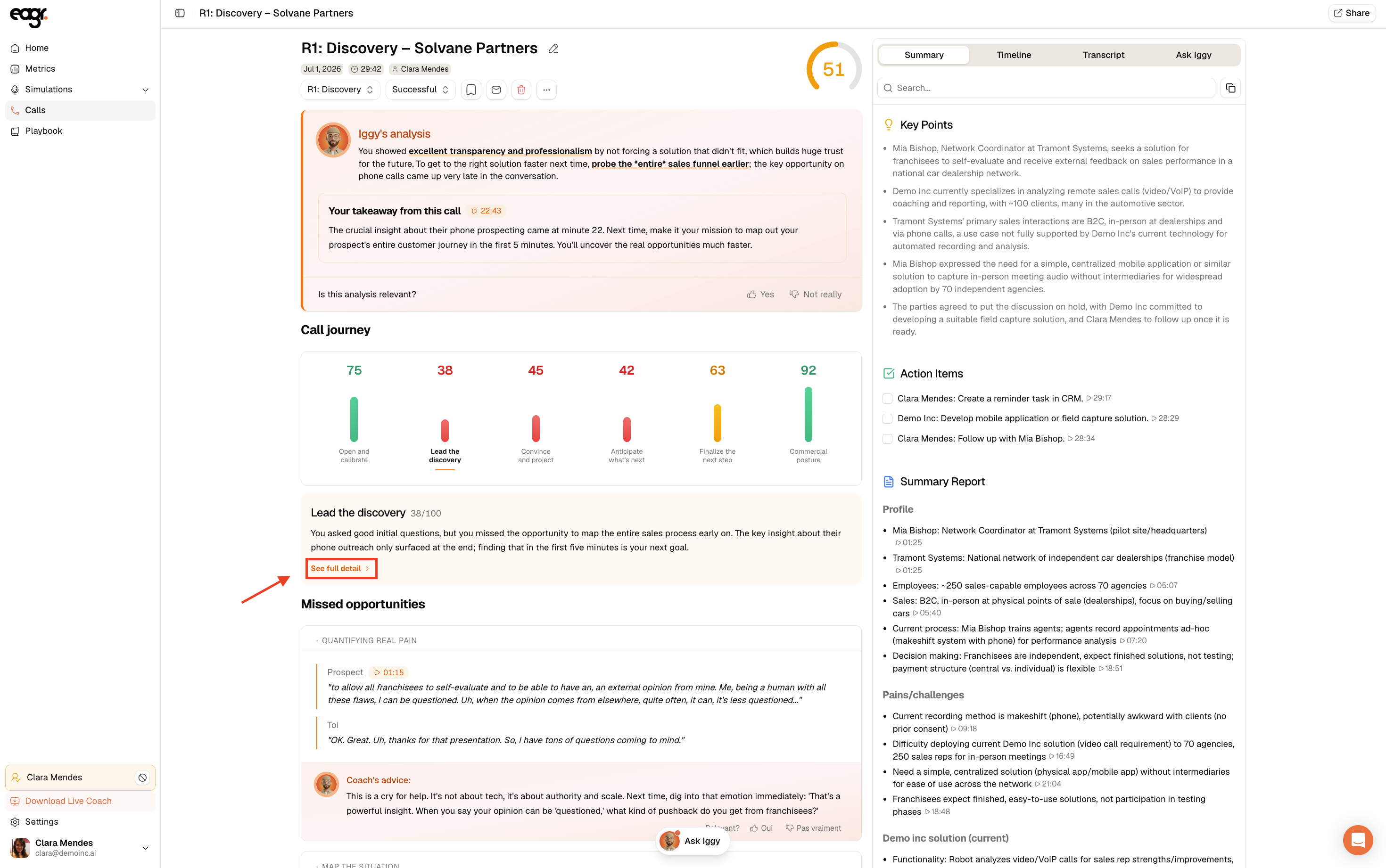
At the top of the call, you see your overall score out of 100. Just below, the Call journey block breaks your score down by competency, also out of 100.
The per-technique detail
Click See full detail. Under the Skills tab, each competency expands into techniques, each with a status:
- Strong: the move is mastered
- Focus: the move to work on first
For each one, Eagr gives you an observation and a concrete improvement: the phrase or reflex that would have taken you up a notch.
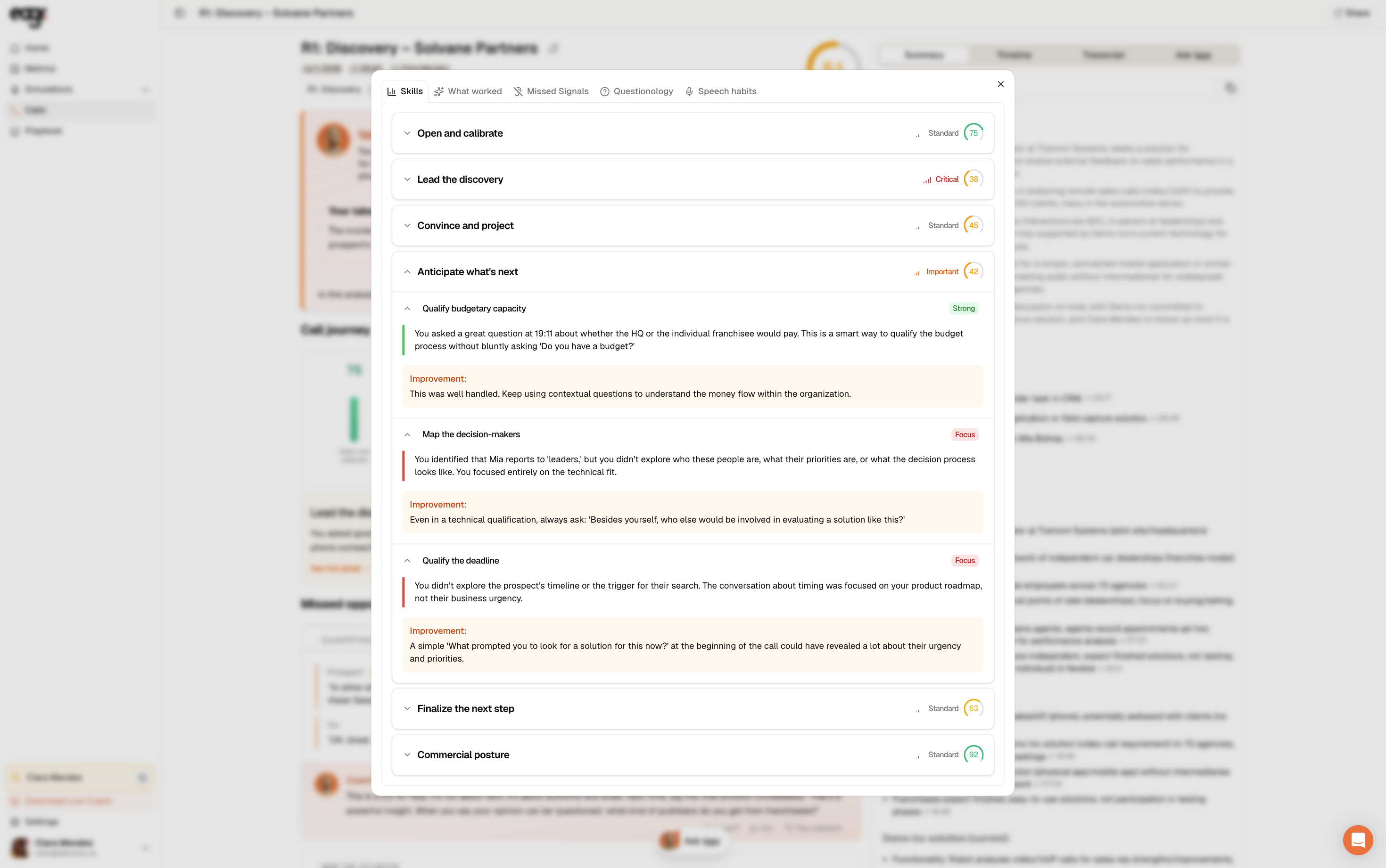
The detail also includes the tabs What worked, Missed Signals, Questionology and Speech habits.
How the overall score is calculated
Your overall score is a weighted average of your competencies: they don't all carry the same weight, the most important ones in the framework count more. A competency that couldn't be evaluated during the call simply isn't included in the average: it doesn't penalize you.
"For an L4…"
Internally, Eagr calibrates each technique on four levels (from level 1, move absent or off-target, to level 4, move mastered with consistency). That's why some advice reads "To reach an L4, you would have…": it shows you the next notch up, not a penalty.
Don't chase a perfect 100. Focus on one technique marked Focus in your next session, apply the suggested improvement, and your score goes up.
Think a score is wrong?
If a technique was mis-detected or mis-scored, you can report it. See Report an analysis error or improve your playbook.